Showing posts with label Kapampangan. Show all posts

Tuesday, January 3, 2012

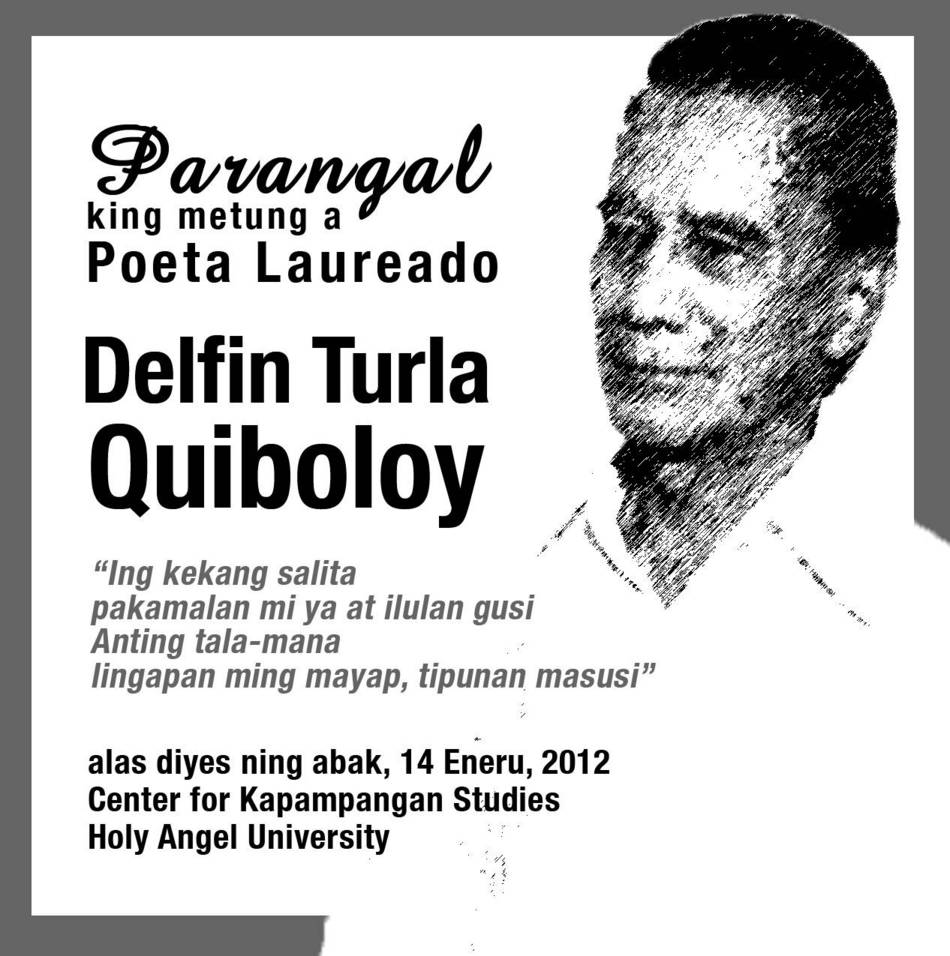
Poet Quiboloy to be honored

Poet Quiboloy to be honored
A Kapampangan poet laureate from Lubao who died in 1999 will be honored by the Center for Kapampangan Studies when it unveils his laurel crown on January 14 at ten o’clock in the morning. The late poet’s family and friends will be joined by CKS officials and local poets in the ceremonies.

Born in 1911 in Sta. Catalina, Lubao, DelfinTurlaQuiboloy was an educator who became a prolific poet and playwright in the 1960s until the 1980s. In 1964 he and other poets founded the Aguman Ding TalasulatKapampangan. In 1969 the United Poet Laureates International headed by Amado Yuzon honored him for his contributions to world poetry in general and Kapampangan literature in particular.
In 1977 he was elected president of the Aguman, and the following year he launched the annual Don Gonzalo Puyat Memorial Awards for Pampango Literature, through the assistance of Senate President Gil J. Puyat.
His poem entitled “IndungKapampangan” won first prize in a poetry writing contest in 1981 during the celebration of Pampanga Day. With another poet laureate, Jose Gallardo, he published the book “Kuriro at Kawatasan.” By the time he died in 1999 he had written more than 200 poems, novels and zarzuelas.
Quiboloy was a town mate and contemporary of DiosdadoMacapagal and Rogelio de la Rosa, who were also poets and zarzuelistas before they became politicians.
The tribute is a partnership between Holy Angel University and Quiboloy’s family led by his son Dante, who lives in the US.

Monday, December 5, 2011

Kapampangan cookbook out soon

Kapampangan cookbook out soon

A milestone in culinary publishing will soon be achieved with the publication of a cookbook that finally showcases traditional dishes in the so-called culinary capital of the Philippines, the province of Pampanga.

“Atching Lillian’s Heirloom Recipes: Romancing the Past through Traditional Calutung Capampangan” features the family heirloom recipes of Lillian Mercado-Lising Borromeo, noted culinary expert from Mexico town.

The book, published by The Center for Kapampangan Studies (CKS), will be launched on Wednesday, December 7 at the Café Juan, Holy Angel University.

According to Joel Mallari, CKS researcher and the book’s editor, the publication is a milestone because it is the first Kapampangan cookbook about little-known folk dishes found in the countryside instead of the usual colonial-inspired dishes that Kapampangans have become known for.

The book introduces traditional dishes like “lagat tucud-banua,” “sabo bulung bonifacio,” “bangus sasmuan,” “zarzuela ning malat,” “bulanglang itu,” “sabo banging nasi,” “bobotung asan,” “talunan manuc,” “paksing demonyu,” “sabo tacsyapu na,” “tinolang tugak,” “kapeng gugulisak,” and many more.

CKS Director Robby Tantingco said the book also contains recipes of the favorite dishes of Kapampangan poet-politician Don Monico Mercado and revolutionary hero Gen. Maximino Hizon, who are among Lillian Borromeo’s forebears.

“The Center collaborated with Atching Lillian because her unique recipes represent a cultural heritage that is fast disappearing,” Tantingco said. “Kapampangan cooking reveals what kind of people we are and what experiences we went through in the past. This is a book not only for every Kapampangan but also for every non-Kapampangan who has tried our cuisine and fallen in love with it.”

For inquiries, contact Myra Lopez at 0920 425 8711 or email kapampangancenter@gmail.com.

Tuesday, March 30, 2010

K-Balen! Baculud at Bamban

K-Balen! Baculud at Bamban: Dng Balen a Mengasagsag


Nung ing Baculud ya mong lalto pekapusu na kanita ning Pampanga, ing Bamban naman ya mong pekapasbul ning Tarlac. Manibat anyang me-Pinatubu la dng dakal a balen keti Kapampangan (dane ning Tarlac-Pampanga), dakal lang menga-apektwan a balen-balen. Mupin metung karing maragul a pamagkasakit keti dng balen ning Concepcion , Porac, Mabalacat, Sta.Rita, Guagua, lalung-lalu na ing Baculud, at Bamban. Ing Baculud ikwa dang misalbag dng keyang memalen, kabang ing Bamban naman inabandona dane dng tau na. Mupin kng Baculud, dng tau kng Baculud la pa murin bobotu at makanyan lapang ‘mamanuli’ dng keyang memalen antimo potang atin maulagang pamagmasusi anti ing Biernes Santu at Pyestang La Naval. Kabang kng Bamban naman matumal pa ing bili ning pamagbalik da ring tau katunayan dakal na karing dating botanti na ing e na pakarehistru kng dating lugal da. Ing Baculud pilit deng tatalakad ing sentru ning pulitika at kultura anya makanyan deng babalikbalikan ing Pisamban San Guillermo, at makanyan yang mibabalik kasikatan ing iskwelang Don Honorio na metung na ngening state university. Kabang kng Bamban, ing munisipyu na mitalakad lang malawut karing pikukumpulan da ring memalen – alayu kng dating kabalenan na kalupa ning Baculud.

Ing Bamban milako ya ‘kabalenan’. Katunayan, mengayna yang tutu ing matwang palengki niting matwang kabalenan (San Nicolas), kabang ing palengki ning Dapdap e bitasang megamit mula pa anyang lumipat la ring tau kng resettlement keti. Ing metung naman na mitalakad kng dating iskwela ning Anupul e ya pa bitasang mibuklat kng publiku. Nanupata, dakal a pigastusan ban mitalakad la reti dng mengasayang mu at minta kng alang nanu. Kabang ing Baculud milako ya ‘pibandyan’ uling alalu dng tau na at dakal dng ati karing bayung labwad – dng resettlement areas na pakasantung karing miyaliwang balen. Keti makanyan lang antimong mangawala munaman dng memalen ning Baculud uling dng anak da ring balang pamilyang memagbakwit kanita lehitimung memalen nala keraklan karing balen nung nu la ati dng karelang tuknangan ngeni.

BALEN A MAWAWALA
Malambat nang panawun mula anyang maumpisa ya ing pekamumunang modern resettlement project keti bangsa. Iti ing Sacobia Development Project kanita pang panawun ning First Lady Imelda Marcos. Masanting a umpisa dapot ngeni nukarin ya? Ati ngeni iti kng magusut a pisasabyan nung nu sangkut la dng balen ning Mabalacat at Clark Freeport Zone. Deti dng kayabe karing mamag-claim a dake kng masasabing sakup ning Bamban. Kng dane ning pangulu naman, dng ‘matwang baryu’ ning Bamban makanyan la naman mengaigut kng kasiping nang Balen Capas. Nanung malilyari? ing Baculud malapad ya pa gabun mupin ditak ya tau, ing Bamban naman dng bisang mamagbalik ala nong babalikan uling dakal nang dayu at balen dng memangwang gabun.

Kasalungsungan, dakal mu naman karing pakatuknang karing resettlement areas anti kng Dapdap dng e tau keti. Ing newly reclaimed areas kng dane ning dating Lourdes , Banaba etc. dakal noman dng mirinan gabun dng e tau keti. Dng dating manuknangan keti bayu ing pamanyalanta ning bulkan, makanyan nomang ala nang balikan. Metung kng masalang kabapustan ing alang malino at eksaktung sukad ning land area at definitve socio-political boundary. Bage na maulaga ban apamalino ya ing ustung pamag-budget ning municipio.

Kng Baculud, lalto magusut pati ing isyu ning pamag-quarry. Dakal lang sasabi na matas munaman ing babayad da ring tau keti kng balas a kukwanan da ban panambak da mu pin naman karing sular a buri dang pasibayung talakaran bale. Bage na pagmasakit dang tutu dng tau.

PASYALAN A E MIDADALANAN
Nanung prublema? Atin yang national highway ing balen ning Bamban, atin yang mangasanting a lugal pasyalan at marangle dapot alang makibalu kng legwan at kayapan nang iti.

Panawun na pa ning pistaym, kabalitan ne kanita karing mangasanting nang pasyalan ing balen. Katunayan, metung ya karing minunang atin azucarera kayabe ning Azucarera ning Tarlac at Pasudeco ning San Fernando at nitang kng Floridablanca. Dakal ya ilug a mangalinis, modern resorts, karinderya at restorant a magtindang manganyaman a pamangan. Iti ing peka-hinterland ning Clark Air Base kanita na pagmulalan da ring Amerikanu at turista kanita. Bayu la memanyikat dng antimo Razon’s Halo-halo ning Guagua at Kabigting’s ampo Jurado’s ning Arayat kng Pampanga at Menila, ing Bamban sikat ne kareting makule at manyaman a pagmarimla – deti deng titinda da kanita ring pakapwestu kanita kng pamosu nang sidepark anti dng karinderyang pakapatulug kng dating Lugay Park. Deti kayabe ning pamamisita kanita kang Apung Lourdes Grotto, at pamamasyal karing dakal a Japanese tunnels, music jamming karing pamosung jukebox kanita, ampo ing minindal a pansit luglug dng kukumpletu kng expiryensya da ring turistang darayu. Katunayan, dakal a natural at makasalesayang lugal dng manaya mung mipasyalan karing potensyal a turista. Ara pin “Nananu ta pa?”

Ing Baculud makanyan munaman. Iti lalu na inyang mekilala yang “Atenas ning Kapampangan” anti nemu waring lugal a pipag-quarry? Nung kasalesayan at gelingan mu naman, iti na ing atin pekamalalam a pibandyan. Salamat namu mika-metung a batas na mikaupayang sumawup ban mibalik ya ing dating legwan ning balen a iti. Iti ing HB 3389, na maglayun ban ma-rehabilitate ya ing mesabing balen. Ban emu kang ‘Santino’ o ken balas ya sumikat pasibayu ing balen nunge mibalik yang tutu ing legwan na niti kalupa na ketang milabas. Sayang pin uling kalupa ning Bamban, dalan-dalanan nemu ning progresung pasibayung tatamasan da ring siping nang balen anti ing Lungsud San Fernando , Guagua at Lubao. Ing Balen Baculud daralanan nemu naman ning Jose Abad Santos Highway (dating Olongapo-Gapan road), metung karing pekamaulagang dalan keti Kalibudtwang Luzon, na manatad kng pang-maragulang kalakal at pamanasensu keti bangsa.

KABYAYAN A MAYAP BIAYAN
Ing Baculud metung yang bukud a balen a atin pekamarakal a tau na mitmung gelingan karing miyaliwang adle ning kabyasnan, legwan at aliwa pang dake ning kayapan dng memalen keta pa mang mumunang aldo. keti la mengabayit dng dakal a gobernador ning Pampanga, ambasador, huwes ning Korte Suprema, doktor, siyentipiku, mambabatas, at miyaliwang lider. Kng malagwang salita, iti ing balen na e lintong memagkasakit kng aske ning pamangabyayan ketang mengapapauna uling bista man at midalanan yang dakal a gera, kalamidad at sakuna dakal ya matenakan a anak a pilit mangitalakad kaniting balen. Katunayan, iti ing dating kapitolyu ning Pampanga at meging kapitolyu ne mu naman ning bangsa ketang panawun ning pamanyakup da ring Ingles. Mupin uling dala na pin ning milabas a Pinatubu at pamaglahar, metung ya pin iti karing balen a mitambunan a kabyayan. At keti la mengapilitan mamagbakwit dng tau at magdatun na pin man karing dakal a resettlement karing miyaliwang balen keti Kapampangan.

Kng kasu na naman ning Bamban, mitulak lang mamaglako dng dakal a memalen anyang panawun na pin ning Pinatubu. Deti memanintunan la kng lwal ning balen. Dakal la ring memanasensu kng lwal, at makanyan namang matumal ing bie kng kilub ning balen.

Kasalungsungan, dng balen ning Porac, kayabe ing Mabalacat pati na ing Baculud manikwa lang mangaragul a panakitan kng pamag-quarry. Kabang ing Bamban nung nu ya dating metung karing manimuna kaniting pamag-quarry ngeni sarili na nang melakwan. Nung kapilan merakal ing balas, makanyan yang lalung megkasakit at mengaramalas.

Kng dane ning Baculud, ing Lungsud San Fernando, Lubao, pati na ing Guagua kayabe ing distritu ning Betis, dng mangatalik a memanasensu. Deti dng balen-balen a pakapatulug kng Baculud. Ing Capas at Mabalacat, pati na ing Concepcion naman dng pakalugal kng dane pangulu at mawli ning Bamban. Ing San Fernando ikwa nang meging lungsud, kabang dng balen ning Capas at Mabalacat ila dng manimunang balen na maka-uring 1st class ngeni. Kabang pilan pang banwa ing milabas anyang makbung ya ing Pinatubu. Iti dala na ning matalik dang pamanasensu, at makanyan la namang papunta kng estadung cityhood. Ing balen Bamban, kalupa ning Baculud, dalan-dalanan ne ning national highway a Mc Arthur na pakadugtung at pakalibutad karing mayasensung balen, melakwan neng palak a kabilyan. Dng memalen keti, manulu na la wawa kabang lalawe la reti kng panyulung a tatamasan dng balen ning Capas, Concepcion, ning Mabalacat, Porac at Botolan – dng limang balen a kasiping ning Bamban. Kabang ing Baculud, makanyan ya pa murin magpumilit na migising. Makalungkut pin uling ing mesabing “Atenas” ning Amanung Siswan eya pa taganang magluwid uling buri da ring aliwang pulitikung managalan na “mabuhay” ya iti imbes na "magluwid" bage na anting tampaling kng sentru ning indung amanung Kapampangan.

DALAN NING DANGALAN
Makalungkut isipan na kng kekaba-kaba ning panawun a delanan dng balen areti, bigla man o ali makanini nemu wari bili deti?

Lalung makalungkut nung sakali, nung kng kerakal-dakal dng tatagal at kakandidatu ngeni, sana kayabe no man kareti dng mangayap, mangatinu, mapagmasabal, maka-tau, matakut kng Dios at dng tune mamuntukan para kng panyulung dng balang balen.

Sana akit tala dng tutung masilbing kasangkapan, para mibalik la tiwala dng keraklan da ring tau keti. Dng tau na mayap mangipakit kng tutung pamangubyernu at karing sara-sariling gelingan dng balang metung kekatamu. Uling ing tutung laban alalu kng ligligan da ring kulayit dng pulitikung kakanditatu karing alalan. Iti atiyu karing dapat, karing platapormang magagawa potang pakalukluk no reng menga-alal a opisyalis. Uling dng tutung lider a mamuntukan aliwa detang "honorable" a balamu ginu lang mangasyas batal potang ati nalu karing munisipyu da ring balang balen, atilu karing tune a susuyu detang e kakargang angin ban e la daragul a buntuk, detang manatili kng lalam at susuyu para kng ikanawa da pamibiebie da ring kapara tamung tau, karing keraklan at ali dng mung mapilan.


Aldo mayaslag pu, kabalen!


-----------
http://www.tarebalakdiscovery.blogspot.com/

Wednesday, March 10, 2010

“Kapampangan as a Tool in Learning -2”

Panagkat mi ya pu…


Center for Kapampangan Studies
Holy Angel University
Angeles City

“Kapampangan as a Tool in Learning -2”
Kapampangan Linguistic Lecture Series No.6


with Dr. Anicia del Corro as Resource Speaker

To be held at CKS, Holy Angel University, Angeles City on March 13, 2010 (9:00 am – 11:am)


Epiphany and finally, a breakthrough
Robby Tantingco

Dr. Anicia Hizon del Corro’s lecture last Saturday on DepEd Order #74 (the Department of Education’s directive making regional languages the primary medium of instruction) was a gathering of hawks and eagles refereed by a dove.
The hawks were the cultural advocates: Fr. Venancio Samson (translator of the Kapampangan Bible and Bergaño dictionary), cultural activist Siuala Pangilinan, Prinsipe ning Parnaso Romeo Rodriguez, Rey Maniago (representing ANASI), Edwin Camaya (DILA), Dr. Lino Dizon, Abraham Tayag, Kragi Garcia, Fray Francis Musni, the officers of the HAU Center for Kapampangan Studies, TSU Center for Tarlaqueño Studies, AUF Institute for Kapampangan Studies BSU Center for Bulacan Studies and representatives of groups like KATATAGAN, AGTACA and Akademyang Kapampangan.
Across the meeting hall were the eagles: Division officials of Pampanga and Angeles City, District supervisors, school principals, and teachers from both public and private schools from towns as far as Arayat, Macabebe, Masantol, Apalit, Minalin, Tarlac and Concepcion.

We expected only 25 attendees but more than 70 showed up—a sign that DepEd #74 was, indeed, a hot topic.

Thank God we had the brilliant and articulate Dr. Del Corro as guest lecturer. Her gentle demeanor and stature as the highest authority on Kapampangan linguistics calmed the tension that potentially existed between the cultural advocates who were pushing for Kapampangan above all other languages, and the educators who wanted only the child’s education regardless of what language was used.
The cultural advocates were also eager to take advantage of the window of opportunity opened by DepEd Order #74, and getting impatient that some educators appeared to be either ignorant of the Order, or confused about its provisions, or slow in implementing it.

As a linguist, Dr. Del Corro reiterated that the sole purpose of a language is to make communication easier, and the sole objective of a medium of instruction—any medium of instruction—is to facilitate the child’s learning. If Kapampangan hampers communication and the learning process, why in the world should we insist on using Kapampangan in the classroom?

Fortunately, DepEd Order # 74 agrees with cultural advocates that Kapampangan does facilitate a child’s learning. This should have settled the debate, but Dr. Del Corro wanted to make sure that the educators appreciated the linguistic principles behind the Order so that they’d understand why they do what they are ordered to do.
She reminded everyone that since the Order’s real intent is not to please cultural advocates but to help classroom teachers teach better and students learn faster, the Kapampangan that should be used in instruction is the kind of Kapampangan that’s easily understood by the students. In other words, the classroom is not the place for cultural advocates to advance their cause of promoting or purifying the language. Language is a tool for education, not the other way around.

In teaching math in Kapampangan, for example, it’s better for the teacher to say “Adua times adua” instead of “Adua ipaspas me king adua,” where the child still needs to know the meaning of “ipaspas” on top of solving the mathematical problem. Obsolete Kapampangan words resurrected from ancient dictionaries or new Kapampangan terms coined by imaginative scholars may please cultural advocates but they don’t help pupils very much.

In the open forum, some teachers aired their worries: Will our graduates become less proficient in English and lose their global competitiveness? How will this Order be received by parents who send their children to school precisely to learn English and Filipino? Where are the Order’s implementing guidelines? Will there be enough Kapampangan materials? What happens to heterogenous classes where minority Visayan, Ilocano, Bicolano and Korean students have as much right to learn as the majority Kapampangan students?

For their part, cultural advocates aired their concern over the apparent foot-dragging in the implementation of the Order, and wondered why some schools haven’t even received a copy of the Order, which was issued last July 2009 yet. They also worried if the Order would be consigned to oblivion just like many other Orders before it, especially with the impending change of leadership in the Department of Education after the May 2010 elections.

At that point Siuala Pangilinan raised the room temperature a few more degrees when he asked why Kapampangans always hesitate to use Kapampangan in the presence of non-Kapampangans. I don’t understand, Siuala said, why we always have to go out of our way to accommodate them at the expense of our own language. Since it was their choice to come and stay and earn a living here, the effort to adjust is theirs to make, not ours.

Just then one teacher stood up and asked her fellow teachers the most important question of all: As teachers, did they sincerely believe that it’s better to use Kapampangan in the classroom? Because if they did not, she said, the Order was doomed right from the start.

I learned, long ago in literature class, that there is a literary technique called epiphany, where a character who’s in the middle of a sticky situation experiences a flash of illumination when everything suddenly becomes crystal clear in his head. This enables him to resolve his predicament and the story gets a happy ending.
What happened in that meeting after the lady asked her question was, I think, a collective epiphany: suddenly confronted with a loyalty check, everyone in the room started professing their love for their amanung sisuan.

One teacher stood up to testify that she had experimented with Kapampangan in her math class and discovered that indeed, it improved her students’ grades. Another said many teachers had actually started translating their textbooks because as Kapampangans themselves, they already knew how to.

A Division official gave the assurance that the Division Office had taken concrete steps to implement the Order and would no longer wait for other provinces or the central office to issue more guidelines because, she said, “we all love our amanung sisuan and want it promoted anyway.”

Romeo Rodriguez and Rey Maniago, speaking on behalf of ANASI and the poets laureate, offered translation and consultation services, and the Center for Kapampangan Studies promised to reproduce the Kapampangan instructional materials it has collated and distribute them to schools. .

We exhorted the educators to seize the golden opportunity and not waste time waiting for more guidelines and being overly cautious by perfecting methodologies and materials before implementing the Order. Kapampangan teachers, being native Kapampangan speakers, are, according to Dr. Del Corro, experts of the language and therefore already qualified to translate and create Kapampangan instructional materials themselves and teach the kind of Kapampangan that pupils can relate to. They can just consult cultural advocates for refinement and integration of Kapampangan culture, history and values.

Cultural advocates, for their part, should realize that they do not have a monopoly of expertise and that they should trust teachers to carry on their own cultural advocacy in the classroom. They should just take comfort in the fact that Kapampangan—any Kapampangan—is now being conveyed to future generations, thus ensuring the survival of the amanung sisuan. It may not be the form of their liking, but it’s still the amanung sisuan.

We all agreed to meet regularly to compare progress reports and share best practices, and to resolve the orthography issue and prepare a grammar book. Dr. Del Corro concluded by giving teachers the assurance that learning Kapampangan does not diminish English proficiency. She suggested that English be taught not as a second language but as a foreign language, whose methodologies and strategies are more focused and stringent and therefore more effective.

We ended the meeting on a happy note, celebrating the hope and the promise that no Kapampangan child will ever again be punished or ridiculed for speaking Kapampangan in the classroom, and that educators and cultural advocates, having finally come together, will now proclaim that yes, Kapampangan is not a hindrance but in fact a key to success.

Published in the SunStar Pampanga newspaper on January 26, 2010.

Monday, February 8, 2010

FORGING PANDAY PIRA

By Joel P. Mallari

Pande Pira acknowledged as the first Filipino metallurgist, was said to have lived between 1483 and 1576. He had devised the cannons using a mold of clay and wax which Muslim leader Rajah Suliman used to protect Manila against the invading Spanish troops. This legendary metalsmith was later recruited to equip the walled city of Intramuros. He set up a foundry for cannons and other artillery for the defense of Manila, founded at the same time as Pampanga. He invented the lantaka, small cannon that could be rotated or maneuvered at any desired angle and direction during battle. He was also asked by the Adelantado Miguel Lopez de Legazpi to manufacture lantakas for galleons and warships as the Spaniards prepared to conquer more lands in the archipelago and throughout Southeast Asia. Prior to this, Pande Pira surprised Rajah Suliman when he made cannons using a mold of clay and wax.

Finding Panday Pira’s Place
Pande Pira was said to hail from the Barrio of Capalangan, Apalit. In some oral documentation he was said to be an immigrant from Borney (Borneo) to Apalit where he had relatives and later decided to settle for good. Other sources say the metalsmith came from Tarlac, while some old folks of Sta. Ana, Pampanga claim his residency to be their place. He was also said to be born in one of the islands in southern Philippines in 1483. Still another account puts the famed expert to have come from Barrio Bangcal of Guagua, Pampanga, and eventually migrated to Apalit after the pacification of the province by the Spanish authorities. Oral accounts among the old Pabustan clans of Pampanga and Tarlac traced their ancestry line with Pande Pira.
He trained the early Kapampangans to make the first iron farm implements and weapons which the Filipinos used to fight for their freedom from the Spaniards from the time Bambalito (a.k.a. Tarik Suliman) led a 4,000 strong warriors from Macabebe in the famous Battle of Bankusay of 1571, and the 1896-1898 revolution, like the “sanbartolome”, the favorite tulipas of Andres Bonifacio. His products, such as kampit (knife), palang (bolo for clearing thicket), panabud (bolo for chopping wood), sudsud (plowshare), talibung (scabbarb), sundang (dagger), lepia (moldboard), lantaka and kabungul (small cannons and culverins) were said to be of such superior quality. When he died in 1576, Spanish officials wrote their king that “no one among us can take his place.” But his craft spread to places like Taal and Balisong in Batangas; Meycuayan, Bulacan; Orion, Bataan; Calasiao, Pangasinan; Santa, Ilocos Sur; Cabagan, Isabela—places where the craft has survived even to this day.


De Morga’s accounts
Accounts of how Pandapira or Pande [panday] Pira became a "cannon-maker" can be traced and credited to Rizal who published an annotated edition of Morga in 1890. Pandapira or Pande [panday] Pira is found in the 5th chapter of Antonio de Morga's "Sucesos de las Islas Filipinas". This chapter relates the events during the term of Spanish Governor-General Santiago de Vera and makes reference to a foundry run by Pandapira:

"[Perez Dasmariñas] established a foundry for artillery in Manila where, owing to the lack of expert or master founders, few large pieces were made."

Thus it can be said that his products were of superior quality that he was recruited as official cannon-maker of Spain for the colony. Ambeth Ocampo notes that Jose Rizal took the opportunity to point out, in a footnote, that the indigenous foundry run by Panday Pira disappeared after the Spaniards settled in Manila. In another edition of De Morga’s work, by W.E. Retana in 1909, A.Ocampo noticed longer footnotes about Panday Pira that include transcriptions of 16th century archival documents from Seville that refute Rizal's nationalistic assertions that cannon-making was a flourishing indigenous industry. The documents from the colonial government in Manila requesting higher authorities in Mexico to send cannon-makers show that the Filipinos were unable to forge the thick European-style cannons. A letter from Governor Vera on June 26, 1587 to the viceroy in Mexico gives an account of his artillery and requests more founders and officers to manufacture cannons. According to Retana, the 26 large pieces alluded to by De Vera could have come from the Spanish ships or from those made by Robles, the Spanish master founder. This made Retana question the skills of Panday Pira and his sons as seen from De Vera's request. Moreover, Retana notes that Robles died before 1587, suggesting that his arrival in the Philippines would have been before that year which was to the time of Pande Pira. However, at that time the natives were already using lantaka and cabungul the much leaner type of cannons, which required different metal technology entirely different from that of the bigger European cannons.


Panday, palang and lantaka
The term "panday" in Java, Borneo, and the Philippines means "metal worker" or "ironsmith." In the Bocabulario of Fray Diego Bergaño, panday means “smithy, a worker on metals, like a silversmith”. Old tradition maintains that Panday Pira even went as far as Ilocos and Isabela in the north and Batangas in the south of Luzon in training the early villagers in the metal smith industry. His name “Pira” may have come from at least two possible origins: pilak, meaning “silver”; or pirah, a two-handed chopping and cutting tool, broad backed with deeply concave blade parang (like the Philippine-Indonesian barong and wedung). The parang is the Malay equivalent of the machete, or the Kapampangan palang, the big knife or bolo.

On the other hand, the swivel cannon known as the lantaka is not exclusive to the Philippines, but throughout Southeast Asia. In Indonesia and Malaysia, the majority of the cannons are Dutch & Portuguese, cast in Europe as well as in their colonies. Usually no longer than 2 meters, it may be as small as 2cm in length, although the average length is 120cm-160cm. It was used in obligatory salutes, ceremonial firings as well as a form of currency. A man’s wealth was determined by the number of cannons he owned. In general, the finer lantakas were cast by the Dutch colonials after 1650 in Malaysia and Indonesia. In fact, the finer detail, design and quality control prevailed as many were founded in Holland for export. A number of foundries were also located in Java and Sumatra, in particular, Batavia - the capital of the Dutch East India Company in Indonesia. These guns were primarily cast as currency for trading spices. The Portuguese lantaka were usually cast in Malaysia and Borneo up to the early 1600's. They were not as refined as the Dutch but rather set the standard design which the Dutch would later replicate, embellishing with various designs.

The word lantaka may have been derived from the Malaysian dialect; it is generally applied to guns of this unique lantaka design. However in Kapampangan, there is a plant called balantakan which bears seed-fruits which are like white beads. In Lubao, these beads when dried were used as pellets for sulbatana (blow-pipe guns) even during the postwar period.

Southeast Asian Panday
Panday experts like Pande Pira most likely had a common ancestry, the Southeast Asians. The Southeast Asian metalsmithing was probably blended with the introduction of Portuguese and Dutch technologies. Pande Pira could have learned the merged culture of metal smithing which had made him the first recognized expert by the Spanish authorities who arrived in Manila, as early as 1511. The Portuguese already made Malacca a trading port - 60 years earlier before the foundation of Intramuros in Manila where he was called to manage a foundry of cannons for the Spanish authorities.

A long period of alliance between the Kapampangans and the Spaniards made the latter’s power stay on foot. The Spanish armada was always reinforced with Kapampangan soldiers and supplied with locally made artilleries of lantaka cannos fashioned after Panday Pira’s influences. Thus to date, one of the finest examples of these weaponry technology are those recently recovered from the wreck of San Diego, a Spanish flagship sank during a naval battle between the Kapampangan reinforced Spanish armada and the Dutch forces led by Olivier van Noort in the Manila Bay area. Archaeologically, most of the artillery finds exhibits Portuguese technology. Thus it is noteworthy to surmise that Panday Pira’s famous indigenous knowledge that time was already influenced heavily by European standard of metal working.

Monday, February 1, 2010

K-Balen! Vicente “Enteng” Manansala (1910-1981)

Vicente “Enteng” Manansala (1910-1981)
Neng Joel Pabustan Mallari

Ing petsang Ineru 22, iyang aldo kebaytan ning metung karing pekabantug a pintor ning bangsa - Vicente Silva Manansala. Ninu mong makaganaka pa kaya? Ninu wari iya? Wapin pala baka ditak lamu o baka ala na.

Miparangalan ya bilang metung karing Pambangsang Alagad ning Kalalangan o National Artist kng Painting anyang banwang 1981, I Vicente Manansala metung ya karing pagmaragul ning bangsa na pasimunu ning istilung “cubism”. Metung ya karing kayanib ning Thirteen Moderns na penimunan nang Victorio C. Edades, at metung karing Big Three ning kimutang modernista, kayabe di Cesar Legaspi at H. R. Ocampo. I Apung Enteng, ing menatagan ketang grupung Neo-Realists kayabe I Romeo Tabuena at Anita Magsaysay-Ho. Iya ing megdevelop kng istilung gagamit “transparent cubism” nung nu dng obra na menasa papakit lang temang makipigura, sasalamin kng metung a balen at lokal a kapaligiran. Iya ing, makiburi kng istilu at paralan da ri Picasso at Cezanne, at manwala yang ing tutung legwan ning kalalangan ati ya kng dalan ning pamaglalang kareti.


I Apung Enteng bayit ya Balen Macabebe, Pampanga anyang banwang 1910. Iya ing kadwang pangane karing walung mikakapatad dang anak di Perfecto Q. Manansala at Engracia Silva. Kng idad a 15, megaral yang pamagpinta ketang pintor a Ramon Peralta kabang makipagobra ya bilang mamangawang karatula karing sine at miyaliwang pwestu Menila. Megaral ya kng School of Fine Arts ning University of the Philippines anyang 1926 at meyari ya anyang 1930. Tiglus na ing pamagral na kng lalam ning kasawpan ning UNESCO grant keta kng École de Beaux Arts ning Banff and Montreal, ning Canada anyang 1949, kabang kng sawup ning gubyernung Pransya, mika iskolarship ya naman kng École de Beaux Arts ning Paris anyang 1950. Ing pamagsane na emu keti meyari, anyang 1960, menikwa ya naman grant ibat kng Estados Unidos ban pagaralan ne ing paralan ning kalalangang “stained glass” kng New York. Makanyan munaman migsane ya kng Otis Art Institute anyang 1967, at tinanggap yang metung pang grant anyang 1970, mula kng bangsang Aleman, ban magaral kanita kng Zurich .

I Apung Enteng, megrobra ya bilang talagulis kng Philippines Herald at Liwayway at bilang layout artist para kng Photonews at Saturday Evening News Magazine karetang banwang 1930’s. At bayu pa iti mekikipagobra ya pang mangabayat anting piun kng metung a konstraksyon anyang gagawan de ing Angat Dam kng Rizal. Pelabas ne ing pekamumuna nang one-man show kng Manila Hotel anyang 1951, at makanyan yang meging propesor kng University of Santo Tomas School of Fine Arts mula 1951 angang 1958. Mitda ya inawa anyang 1981 keta kng Makati .

Dakal karing mangsanting nang obra dng sinikat at pigkagulwan da ring kolektor at kritiku ning kalalangang biswal. Kayabe keti ing antimo ing Bangkusay Seascape (1940); Banaklaot (1948); Madonna of the Slums (1950); Jeepneys (1951); Reclining Mother and Child (1967). Makanyan munanan, mekagawa yang dakal a myural antimo ing “Stations of the Cross” ning UP Diliman Chapel, Myural ning Philippine Heart Center, Fresco myural ning National Press Club. At nung parangal mu naman at gawad pamangilala bukud kng post-humous award na binye ra kaya anyang mate ya, dakal la dng e abilang a kagalalan na dng ikwa na, deti dng megsilbing katunayan nung makananu ya kakinang ing gelingan na kng adle ning kalalangan biswal – ing arte na sasalamin kng kabyasnan at kabilyan da ring Pilipinu kanitang panawun na.

Kng kasalungsungan, bukud pa kang meangubieng Apung Enteng, dakal na ring Kapampangan dng memanikwang galal bilang Pambangsang Alagad ning Kalalangan antimo di Francisca Reyes Aquino, Galo B. Ocampo, Bencab, Fernando H. Ocampo, pati di Manuel Conde, Virgilio Almario, FPJ at Carlo J. Caparas. I F.R.Aquino na tau San Miguel, Bulacan ing mekilala kanita kng dake ning terak, kabang di Galo Ocampo (ning Sta.Rita) at Benedicto “Bencab” Cabrera (ning Sasmuan/ Malabon) naman kalupa de kategorya I Manasala kng dane ning kalalangang biswal. I Virgilio “Rio Alma” Almario (ning San Miguel) naman kng dake ning literatura at Manuel Conde, Magno Jose "Carlo” Caparas parewung batukan noman kng pamagdirek pelikula, kabang I Fernando Poe, Jr. naman bilang metung karing mangagaling a aktor ning pelikulang Pilipinu. Anya nung I Manansala sinikat ya karing dakal nang obrang miki-istilung cubism, I Galo Ocampo naman ketang pamosu nang “Brown Madonna” at ketang disenyu nang “Seal of the Philippine President” na gagamitan da pang opisyal ngeni. I Bencab naman karing daramatiku nang kagulisan karing miyaliwang temang makipigura. I Almario bukud kng dalubasa ya kng masasabing wikang Filipinu, dakal ya kawatasan, kwentu at sanese dng mengapalimbag, kabang ing kabalen nang I F.Aquino naman ing mayap a talasalugsug karing miyayaliwang katutubung terak dng Pilipinu kanita. Makanyan mu naman kari Conde, Caparas, at FPJ bukud kng mangagaling lang direktor karing pelikulang Pilipinu, ila dng memagpasikat karing palabas a atin temang maka-Pilipinu antimo dng seryeng “Panday” kanita na dinirek nang Caparas (na sinulat na pa ketang mumuna karing komiks) at lebasan na naman FPJ.

Nanupata, dakal a gelingan ing kasangkap na na ning aldoldong pamibiebie. Mupin, dakal karing gelingan a reti dng mengayambag na kanita manga na ngeni dng ena mapapansin. Antimo ing logo ning Ginebra San Miguel na ginulis na kanitang Fernando Amorsolo, metung a magaling a pintor ketang panawun na ing ala nang makabalu man o makaganaka maging karin mang dakal a talakainum at magpakalasing kng alak a iti. Anya masampat mung dng artista, pintor, at dakal a gogosa pa para kng ikalagu ning arte ning bangsa ing map mung miganakan o mipagmasusyan. Emu tutuknang kng mirinan lang parangal bilang Pambangsang Alagad ning Kalalangan nunge ing akit da ring memalen ing gewa ra, ing ulaga da reti at makananu lang mekasawup o makasawup para kng mayap a pamangabyayan at karangalan a abibye ra emu karing Kapampangan nunge pati na dng Pilipinu kng pangkabilugan. Makananu pa kaya nung dng aliwang pakakalulu mu pin mangayap at mangatinung artista, pintor, at dakal pa dng anga na ngeni dng e makikilala dng alang patugut munaman makakalingwan kng kilub ning aldoldo? Di Tang Aurelio Lobo, Pabs Rosas, Nick Cunan, Pablo Pineda, Frank Arcega, Leonardo Tulabut, Perfecto Mercado, Oskar Yabut, Eduardo Santuangco, Boy Mallari, at dakal pa…Lwid kopu. Gumulis, at magpinta tapa pu, dakpan tala pa pu kule dng miyaliwang kwentu ning pang-aldoldong bie. Ban emu dng kayanakan a pintor at talagulis dng kekong arinan inspirasyun nunge ing mabilug a memalen a Pilipinu.

Masayang aldo ning kebaytan nang kabalen Vicente Silva Manansala ning Balen Macabebe!
Makilakalatug pinggan ke pu!


VICENTE “ENTENG” SILVA MANANSALA

Research compilation by Joel Pabustan Mallari
Center for Kapampangan Studies
Holy Angel University , Angeles City

Vicente Silva Manansala (22 January 1910-22August 1981) was a Philippine cubist painter. Enteng as he was fondly called by his contemporaries is a Philippine modern painter known for popularizing Cubism. In 1981, he was posthumously recognized as one of the National Artists of the Philippines in Visual Arts. His signature style is based on Cubism, but rather than breaking down figures, shows them through transparent angular forms.
Enteng is the first Kapampangan to get a title National Artists of the Philippines , where the likes of his fellow kabalen visual artist followed suit, namely Galo Ocampo of Sta.Rita and, Bencab of Sasmuan.

Kapampangan background
Enteng was born in 1910 in Macabebe, Pampanga, the second of eight children. The year before he started college, he worked as a painter of movie posters. He married Hermengilda Diaz in 1937. He died in 1981 in Makati .

Scholarly education
He studied at the UP School of Fine Arts for 1926-1930 . He went abroad for further studies on a six-month UNESCO grant to Ecole de Beaux Arts in Banff and Montreal , Canada in 1949 and a nine-month French government scholarship to the Ecole de Beaux Arts, Paris in 1950. In 1960 he received a U.S. Dept. of State Specialist grant to study the making of stained glass in New York . He also took further studies at the Otis Art Institute in 1967. In 1970, he received a German grant and went to study in Zurich .

Vivid career
Enteng was a billboard painter and laborer at the Ipo Dam Construction in 1930. He also worked as a an illustrator in 1941 for the Cultural Office of the Japanese Occupational Government. In 1941 he won first Prize in UST’s National Art Exposition for "Pounding Rice". His first one-man show was in 1951, at the Manila Hotel. This was subsequently followed by 7 others. He became one of the Thirteen Moderns and with Hernando Ocampo and Cesar Legaspi formed the triumvirate of neo-realists.
Manansala taught at the UST School of Fine Arts from 1951-1958. He made numerous murals, including the fifteen stations of the Cross for. U.P.’s Church of the Holy Sacrifice; the mural in the Philippine Heart Center; and a fresco mural for the National Press Club.

His major works include:
• 1940 – Bangkusay Seascape
• 1948 – Banaklaot
• 1950 – Madonna of the Slums
• 1951 – Jeepneys
• 1967 – Reclining Mother and Child

He also painted several historical murals including:
• Stations of the Cross for UP Diliman Chapel
• Mural for Philippine Heart Center
• Fresco mural for the National Press Club

Prized achievements:
• 1941 – 1st Prize, National Art Exhibition, UST, for Pounding Rice
• 1950 – 1st Prize, Manila Grand Opera House Exhibition, for Barong-Barong #1
• 1950 – 1st Prize, Art Association of the Philippines First Annual Art Competition, for Banaklaot
• 1951 First Prize, Republic Exposition
• 1951-58 Professor, UST School of Fine Arts
• 1953 – 2nd Prize, Art Association of the Philippines, for Kahig (Scratch)
• 1955 – 2nd Prize, Art Association of the Philippines, for Fish Vendors
• 1955 – 3rd Prize, Art Association of the Philippines, for Best-Served, Well-Gained
• 1957 – Outstanding UP Alumnus
• 1962 – 2nd Prize, Art Association of the Philippines, for Give Us This Day
• 1962 – Best in Show, Art Association of the Philippines, for Give Us This Day
• 1963 – Republic Cultural Heritage Award
• 1970 – Patnubay ng Sining at Kalinangan Award, from the City of Manila

Enteng’s Timeline
• 1910 Born the second of eight children Jan 22 in Macabebe, Pampanga
• 1925 Worked at a Manila painting shop doing movie posters; First oil painting
• 1926-30 UP School of Fine Arts
• 1930 Billboard painter and laborer in the Ipo Dam Construction
• 1937 Married Hermenigilda Diaz
• 1934 Worked as a mess boy aboard the English ship Silver Palm
• 1941 Illustrator, Cultural Office in local Hodobu, Japanese Occupational Government
• 1941 First Prize, National Art Exposition by UST for "Pounding Rice".
• 1949 UNESCO grant to study in Banff and Montreal , Canada
• 1950 First Prize, Art Association of the Philippines First Annual Art Competition for Banaklaot; Key synthesizer of Neo-Realism style
• 1950 French Government scholarship to study at the University of Paris
• 1951 First One man show at the Manila Hotel; seven others since
• 1951 First Prize, Republic Exposition
• 1951-58 Professor, U.S.T. School of Fine Arts
• 1957 Outstanding UP Alumnus Distinction
• 1960 U.S. Dept. of State Specialist grant to study stained glass techniques in New York
• 1963 Republic Heritage Award
• 1967 Otis Art Institute
• 1970 German grant to study in Zurich
• 1970 Araw ng Maynila Award
• 1981 Died in Makati
• 1981 Proclaimed NATIONAL ARTIST (posthumous)
• 1992 The World of Manansala- Metropolitan Museum of Manila

Selected references
Duldulao, Manuel. A Century of Realism in Philippine Art. Quezon City :Legacy Publishers, 1992.
http://iloko.tripod.com/Manansala/ Timeline of Manansala’s Life
http://www.ncca.gov.ph/about_cultarts/comarticles.php?artcl_Id=169 Hernandez, Eloisa P. “The American and Contemporary Traditions in Philippine Visual Arts.”
Duldulao, Manuel D. 1988 (revised edition of 1982 work). A Century of Realism in Philippine Art. Hong Kong : Toppan Printing Company and ORO BOOKS.
Duldulao, Manuel D. 1993. Twentieth Century Filipino Artists. Quezon City : Legacy Publishers.
Hofilena, Ramon, H. 1974. Manansala. Silay City . 24 p. monograph. 500 copies printed.
Paras-Perez, Rodolfo. 1972. From the collection of Dr. and Mrs. Guillermo
Damian: Manansala Landscape Watercolors. 20 p. Manila . 23 cm.
Paras-Perez, Rodolfo. 1995. Edades and the 13 moderns. (compiled with Belen Ponferrada and Victoria T. Herrera). Manila : National Commission for Culture and the Arts, Committee on Visual Arts. 85 p. 31 cm.
Bale dugpanan/ Home

Ing mamulabug

Ing mamulabug
Tarebalak pangpang